
But aside from the social science evidence on family structure one quesiton I have for you is this:Wow. Just wow. We need an analyst in here, stat.
My eldest son's father abandoned me and his son. We were never maried. He never wanted to have children, he wanted to have sex and companionship.
What was wrong with what he did, if anything?
He didn't violate any vow or contract. He never asked to have a baby.
By what standards do we htink fathers are responsible for the children they make, if we don't think procreation and biology matter?
Thursday, October 20, 2005
She said I gave my heart too soon/and that's how I became your mother
I've found Maggie Gallagher's guest blogging stint on the Volokh Conspiracy mostly boring, with a generous side of depressing and a dash of infuriating (as someone who doesn't want to procreate, I find Gallagher's theory that real marriage is all about the baby-making rather offensive). Many people have speculated on Gallagher's real motives. I found this passage from one of her brief excursions into the comments sections illuminating:
Choosing
I first saw this Washington Post article via the Corner (hush, I need to get my Miers news!). Ampersand has a very thoughtful response to it. For this pro-choicer, it seems like a very easy decision to make; if we contend that a woman should not be condemned for choosing to abort if she couldn't handle having a non-disabled child, why should the calculus change when we know that the child is disabled? Surely we don't have more of a duty to carry disabled children to term than we do non-disabled children?
Speaking of abortion, here are some links to organizations that provide financial assistance for poor women who want abortions in Texas.
Speaking of abortion, here are some links to organizations that provide financial assistance for poor women who want abortions in Texas.
Wednesday, October 19, 2005
50 Book Challenge #56: The Wasp Factory
The Wasp Factory is probably the most detailed literary window into murderous madness I've peered into. The narrator, Frank Cauldhame, admits to having killed two cousins and a brother but claims that he doesn't intend to kill again, as "[i]t was just a stage [he] was going through."
Banks has created a parallel world for sixteen-year-old Frank and his father, Angus; they live on an island, which Frank protects with talismans and divinatory magics he has fashioned out of animals and insects he's killed. Frank's was an unregistered birth, and he was gruesomely injured at a young age, so he only interacts with the outside world when he heads down to the pub for drinks with his only friend, a dwarf. The rest of the time, Frank patrols the island with a satchel full of pipe bombs and dead animal heads. Frank is unsettled by the prospective return of his brother, Eric, who is as mad as Frank but in a more dramatic way (he was institutionalized after burning the village's dogs and trying to force children to eat worms). Eric has escaped and is making his way back to the island, leaving a trail of burnt dogs in his wake.
Frank is deeply introspective, but while he is able to recognize both his brother's and father's mental problems (Angus is obsessive-compulsive at the very least) and the social unacceptability of his murders, only at the end does he seem to obtain some meaningful self-knowledge.
[Spoilers follow; highlight to read.] When the book's final twist manifests itself, I felt a curious softening toward Frank. His previous actions suddenly seemed less of the product of an alien intelligence and more sympathetic. That the book elicited this reaction made me very uncomfortable; I can only assume that it happened because I am a woman, but it strikes me that there's something extremely problematic about suddenly becoming more forgiving of multiple homicide just because it's a fellow XX chromosome carrier who did the deed. There's something deeply at work here with regard to societal views of female killers and internalized stereotypes, and as a self identified feminist it made me feel roughly the same way most believers in racial equality feel after they take one of those implicit association tests and it tells them they're prejudiced. This sudden rush of sympathy for Frank, more than anything else in the novel, unsettled me.
I'd recommend this book to anyone who watches Silence of the Lambs because they like Hannibal Lecter.
Tuesday, October 18, 2005
Animated GIF Parade
In the tradition of Boromir's Magic Phone and its amusing fellows, I offer you this. (No, I don't play World of Warcraft.)
Monday, October 17, 2005
NYC Whiskey Tango Foxtrot Moment
My own personal best WTF? moment, from when I was living in Brooklyn two years ago:
At work, I impaled myself on a toothpick sized splinter from the edge of a table in the library. I limped to a bathroom to remove the splinter and realized that last 0.3 inch of stick was stuck in my upper thigh. Attempts to remove the chunk of wood failed.
I returned to my department in panic, remembering parental admonitions that splinters left in flesh would fester and realizing that a festering wound and my planned weekend trip to D.C. were incompatible. I went to ask my boss for a first aid kit. However, she was in conference with the other prosecutor for our case and some random witness type. I burst into tears of pain and embarassment and told the head prosecutor that I would try the drug store across the street.
I went to the drugstore and looked unsuccessfully for first aid kits. Questions posed to a wandering employee were ignored. I repeated with another employee: ignored. Surrounded by people wearing drugstore aprons who refused to acknowledge my presence, I announced my general need to the room at large; this too was ignored. Finally, I approached a socializing concentration of said employees and asked if any of them worked there and where the first aid kits were. (I was giving them the benefit of the doubt and supposing that it was possible the people I asked were not on shift.) I received a curt answer and laughter as I turned to go. At this point, red-faced and with a chunk of splinter wiggling deeper into my leg, I turned back and pronounced that none of them *acted* like they worked there.
One employee then called after me to "Come back here, bitch, I'll punch you in the face an' knock you out."
At this point I walked off and finally found the first aid kits and burst into tears again. I then informed the manager of his employee's threat and described her. At this point I went to check out and realized A) the store is so poorly run that no one is at the register, B) I should not patronize establishments that employ such hooligans, and C) if I am around when the manager comes back I may have to confront a violent soon-to-be-fired woman who will almost undoubtedly attack me, and I already have enough personal care emergencies to worry about.
I walked all the way home with the splinter working its way into my leg. I spent 20 minutes at home and finally managed to CUT it out using a razor blade and a needle, as it was jabbed in at a 45 degree angle instead of just under the skin. I realized then that my bandaids were with my tweezers (which I also missed sorely, let me tell you) in the suitcase at the office that was packed for my trip to D.C. I tried to tape a ointment smeared wad of toilet paper to my leg but ran out of tape, so I tied it around my thigh with a piece of grosgrain ribbon and walked back to work.
(Yes, I realize I am a big wuss. My mother did inculcate me with a horror of splinters, though, and even the biggest wuss in New York shouldn't get punched in the face for asking for Neosporin.)
Wrong piled upon wrong
I had a friend in high school who was totally obsessed with ODB. She wanted to marry him and have his gold toothed babies. So wherever you are, Mayumi, this one's for you.
(Karl, where do you find this stuff?)
(Karl, where do you find this stuff?)
50 Book Challenge #55: On Love
A friend prescribed Alain de Botton's debut novel, On Love, as appropriate reading for the recently heartbroken. While a better title for some chapters might have been "On Limerence," de Botton does, in his sequence of numbered paragraphs and careful diagrams, break down the life cycle of a relationship in acutely perceptive ways. He coins terms for many of the incoherent thought processes incident to such attachments, including "romantic Marxism" (not wanting to be a relationship with anyone who would want to be in a relationship with you) and "romantic terrorism" (the attempts to extract what cannot be freely obtained from the beloved through sulks and guilt trips).
While de Botton's narrator is almost a caricature of immaturity and inexperience in some respects, the melodramatic last chapters may remind the reader of his own less extreme youthful excesses even if they do not inspire identification at present. His obsessive cataloguing of the myriad ways in which love makes mountains out of molehills by sheer virtue of the strength of the emotional currents involved makes for an extremely enjoyable read, and if I smiled wryly more times than I laughed out loud, that is my fault and not de Botton's. Highly recommended to anyone who has been in love or one of its close emotional relations.
While de Botton's narrator is almost a caricature of immaturity and inexperience in some respects, the melodramatic last chapters may remind the reader of his own less extreme youthful excesses even if they do not inspire identification at present. His obsessive cataloguing of the myriad ways in which love makes mountains out of molehills by sheer virtue of the strength of the emotional currents involved makes for an extremely enjoyable read, and if I smiled wryly more times than I laughed out loud, that is my fault and not de Botton's. Highly recommended to anyone who has been in love or one of its close emotional relations.
Saturday, October 15, 2005
Is your butt round like the letter C?
Geoffrey won't appreciate this, but some of you sickos might. It's Baby Got Back, folk singer style.
Crying at the movies
The first time I can remember crying at the movies (as opposed to hearing stories about how a young me cried like a baby at some Disney flick where the mom dies) was when we think Jack Lemmon's character dies in Grumpy Old Men.
This shames me to this day.
This shames me to this day.
50 Book Challenge #51-54: Mirror Dance, Komarr, A Civil Campaign, and Diplomatic Immunity
At the urging of some of my commenters and against my own gut instincts, I checked out as many of the more recent Vorkosigan books as the Clerksville library had available. I was pleasantly surprised by the quality of these books, as compared with Bujold's newest work, and am now begrudgingly willing to acknowledge that some of her more enthusiastic partisans may have a point.
The character of Mark, with his flaws, eagerness to dive into the world of entrepreneurship, and psychological complexity, was perhaps the most appealling aspect of both books in which he figured. Mirror Dance got boring whenever he was offstage; I was far more interested in what Mark was going to do than where Miles was. This is no doubt a result of my lack of previous attachment to the character and Miles fans will chide me for my cold-heartedness.
A Civil Campaign lost some momentum when it became bogged down in Barrayaran politics instead of the delicate manueverings of people in love, but it was probably the most enjoyable of the books I read. At several points I laughed out loud, but then comedies of manners do appeal to me much more than the more modern sort.
Diplomatic Immunity definitely was the most tightly plotted of the four, although the motivations of the ba remained rather opaque, even after the neat explanation in the final chapter. And again with the babies! You know, I'd love a well written and psychologically perceptive SF or fantasy book with characters in adult relationships who don't go all hormonal and baby-crazy. Any recommendations?
Komarr was necessary, I suppose, as an introduction to Miles's love interest, but in all other respects is was underwhelming and dull. As mystery subjects go, murders and kidnappings are innately more interesting than embezzlement.
I don't plan on reading any more Bujold, but somehow I've been bullied into reading ten of her books this year alone, so saying that may just provide more incentive for people to write and suggest yet more titles that will display her subtle talent.
Friday, October 14, 2005
Internet romances are good.
Sometimes someone drops a bit of gossip and a million things that didn't really make sense fall into place. Then, just as quickly, everything crumbles into a puzzling jumble and you realize that even with this new tidbit, nothing makes sense either, but in new and exciting ways.
UPDATE: Edited to change the title. My sincerest apologies for giving offense.
UPDATE: Edited to change the title. My sincerest apologies for giving offense.
Bond should be revoked.
The new Bond is hideous. He looks like someone I would begrudgingly let in my apartment to fix the wiring, not a sexy secret agent.
Whoever vetoed Clive Owen should be chastised.

Whoever vetoed Clive Owen should be chastised.
Thursday, October 13, 2005
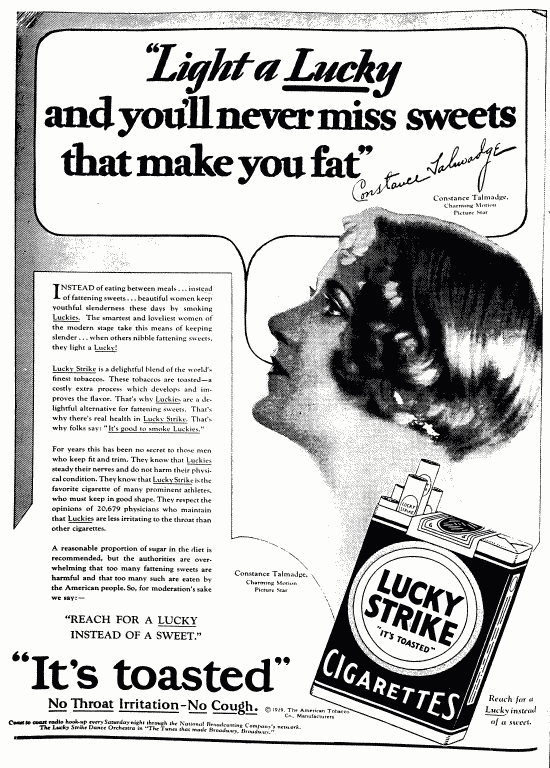
Reach for a Lucky Instead of a Sweet?
This Slate article hypothesizes that America might have been better off, public health-wise, before the anti-smoking crusade of the last twenty years. I wouldn't agree with Sepkowitz that "the trail of misery, illness, and death etched by cigarettes remains unparalleled in the history of mankind," but neither am I ready to reach for a Lucky instead of a sweet.
Domino
I recently saw a preview for Domino, the new film that's based on the true story of a beautiful young British woman who becomes a bounty hunter in Los Angeles. The trailer was way too talky and revealed too much of the narrative; they really needed something energetic, with lots of quick cutting and a little mystery left intact to fascinate young women who might want to see it to figure out how a poor little rich girl ended up breaking down doors in L.A.
The NY Times profile reveals that one of the juiciest scenes in the film was fabricated:
The NY Times profile reveals that one of the juiciest scenes in the film was fabricated:
Mr. Scott depicted one of Ms. Harvey's most dangerous exploits in the film. She, Mr. Martinez and Choco entered a room expecting to find only one person and were met by at least a dozen gang members with guns drawn. In the film Ms. Knightley gets out of the jam by offering lap dances, something Ms. Harvey did not do.Now I understand that a Hollywood movie featuring a starlet like Ms. Knightley needs a hot scene or two, but what I really want to know is how the real Domino got out of that pickle. That would be an excellent action sequence, or at least a clever suspense bit.
Fame!
My snark on the fictitious Constitution in Exile movement works its way into Pejman Yousefzadeh's latest TCS piece.
Wednesday, October 12, 2005
Tomay-to, Tomah-to?
I thought it was just a lazy college student phenomenon, but apparently the use of a duvet without sheets is some sort of European and British cultural oddity. I will go on record as thinking this is gross and probably energy-inefficient. The duvet is the big gun of bedding; how could you possibly sleep with only a heavy duvet year-round? Mine slowly creeps up as winter sets in; right now it keeps my feet warm, but by January I'm sure it will be pulled up to my chin. And I'll have sheets!
Tuesday, October 11, 2005
Note to self
Free alcohol + opinionated law clerks + recent Supreme Court precedents = Nothing good. From now on, the shop talk stays in the office.
And the associates cheered . . .
Blackberry service in the U.S. to be cut off?
I had the chance to be around a large group of young lawyers recently and too many of them were slaves to their Blackberry, even during a purported period of leisure. One said that he regularly received emails from both other firm attorneys and clients at all hours. The Blackberry allows such senders to expect a response. But attorneys aren't doctors; there's no need for us to be on call 24/7. There's especially no need for summer associates to be so tethered. Maybe being cut off from all this is exactly what young lawyers need. But will they get it? (h/t)
I had the chance to be around a large group of young lawyers recently and too many of them were slaves to their Blackberry, even during a purported period of leisure. One said that he regularly received emails from both other firm attorneys and clients at all hours. The Blackberry allows such senders to expect a response. But attorneys aren't doctors; there's no need for us to be on call 24/7. There's especially no need for summer associates to be so tethered. Maybe being cut off from all this is exactly what young lawyers need. But will they get it? (h/t)
Subscribe to:
Posts (Atom)