Monday, May 16, 2011

Peaking early

Apropos of recent discussions:
The fall from childhood greatness to a middling state of “simply okay” is, Gladwell suggested, a recurring theme when the cherished notion of precocity is subjected to real scrutiny.

“I think we take it as an article of faith in our society that great ability in any given field is invariably manifested early on, that to be precocious at something is important because it’s a predictor of future success,” Gladwell said. “But is that really true? And what is the evidence for it? And what exactly is the meaning and value of mastering a particular skill very early on in your life?”
...
We think of precociousness as an early form of adult achievement, and, according to Gladwell, that concept is much of the problem. “What a gifted child is, in many ways, is a gifted learner. And what a gifted adult is, is a gifted doer. And those are quite separate domains of achievement.”
...
When we call a child “precocious,” Gladwell said, “we have a very sloppy definition of what we mean. Generally what we mean is that a person has an unusual level of intellectual ability for their age.” But adult success has to do with a lot more than that. “In our obsession with precociousness we are overstating the importance of being smart.” In this regard, Gladwell noted research by Carol Dweck and Martin Seligman indicating that different dimensions such as explanatory styles and attitudes and approaches to learning may have as much to do with learning ability as does innate intelligence. And when it comes to musicians, the strongest predictor of ability is the same mundane thing that gets you to Carnegie Hall: “Really what we mean … when we say that someone is ‘naturally gifted’ is that they practice a lot, that they want to practice a lot, that they like to practice a lot.” (emphasis added)
Are we confusing correlation with causation when we interpret results like the association of practice hours with ability? Isn't the liking significant?

Too, the sorts of skills and subject for which we label precocity as significant are often not those for which mere repetition and practice suffices to make one a "gifted doer."

Sunday, May 15, 2011

On tittle-tattle and privacy laws

From the "legality is not synonymous with morality" files:
Such stories constitute little more than idle gossip and are often embarrassing, even distressing, to their subjects. But so long as such gossip has not been acquired through illegal means, through invasion of privacy in the first sense, and so long as it is not untrue, it should not be a matter for the law. This is not to say that such journalism should be deemed acceptable. It should not. Passing off gossip as news has helped lead, as Polly Toynbee pointed out almost a decade ago, to ‘everyone’s loss of civility’, to the undermining of ‘everyone’s sense of a discreet private space which should stay beyond the brazen megaphone of public exposure’. There is, however, a big difference between that which should be unacceptable and that which should be illegal. Just because something is legal does not make it morally or socially acceptable. Conversely, just because something is morally or socially unacceptable should not make it illegal.

Friday, May 13, 2011

A question answered

Why Europeans would read someone like Franzen:
For the American reader there is the pleasure of recognizing the interiors Franzen so meticulously describes. Not so for the Italian, or German, or Frenchman, who simply struggles through lists of alien bric-a-brac. We might say that if the Swiss Stamm, to attract an international public, has been obliged to write about everyman for everyone everywhere, Franzen, thanks to the size of America’s internal market, but also to the huge pull the country exercises on the world’s imagination, can write about Americans for Americans (which is no doubt as it should be) and nevertheless expect to be read worldwide.
...

Freedom has this characteristic: Franzen appears to get all his energy, all his identity, from simultaneously evoking and disdaining America, explaining it (its gaucheness mostly) and rejecting it; his stories invariably offer characters engaging in the American world, finding themselves tainted and debased by it, then at last coming to their Franzenesque “corrected” senses and withdrawing from it. Blinded by this or that ambition, they come to grief because they lack knowledge, they lack awareness. Thus the importance of so much information. Unlike his characters, Franzen knows everything, is aware of everything, and aware above all that redemption lies in withdrawal from the American public scene. What message could be more welcome to Europeans? The more you know about America, which we need to do, the more you turn away from it, which we enjoy.

Tuesday, May 10, 2011

What About the Paper Tigresses?

This NY Mag article on what happens to parent-propelled Asian students once they finish school and enter the real world was much better than it could have been. (To the extent that Yang writes about his experiences and personal philosophy, it's rather insufferable; his insight into and skill in portraying others is far superior to his ability to objectively analyze himself.) But this post very neatly points out that much, if not most, of the article is applicable to reserved, nerdy boys of all races, and that almost none of it applies to Asian girls. The author nods in Amy Chua's general direction, but skims over how the fact that she is raising daughters affects the application and effects of tiger-parent principles. Are these girls victims of Martha complexes? What happens to Asian Marthas when they graduate? I doubt their experiences track Yang's, or necessarily those of the Asian men he profiled.

Monday, May 09, 2011

50 Book Challenge Mea Culpa

I have totally fallen behind on my reviews for the 50 Book Challenge, even though I have read dozens of books since the last post. I can recommend The Fever by Sonia Shah and the Fandorin mysteries by Boris Akunin. I'm also really enjoying The Thousand Autumns of Jacob De Zoet as an audiobook. Anything strike your fancy lately? I've got to pencil in time for rereading A Song of Ice and Fire before July, but otherwise I just have a couple of civil war histories on the to-read shelf.

Thursday, May 05, 2011

How to make me hate you, publishers

Prices on Amazon of various versions of a book I want (prices of real books include free two-day shipping):

Paperback, new:     $10.20
Kindle eBook:         $11.99 (noted by Amazon: "This price was set by the publisher")
Hardcover, used:    $4.00
Paperback, used:    $3.98

Guess which one I bought? What kind of suckers do they think they are dealing with here?

Wednesday, May 04, 2011

We are being trolled by the WSJ

With this article, which combines the gobsmackingly obvious with stereotyping psychobabble garbage.
The female cortex contains a highly developed system for finding and scrutinizing a prospective partner—a system that might be dubbed the Miss Marple Detective Agency. Agatha Christie's fictional sleuth is often dismissed as scatterbrained, but she is actually a shrewd judge of character and harbors deep knowledge of the dark side of human nature. She uses her surprising analytical acumen to solve mysteries that have stumped the police.

Using similar investigative skills, the female brain evaluates all available evidence regarding a potential mate's social, emotional and physical qualities to make an all-important decision: Is he Mr. Right or Mr. Wrong? Only if Miss Marple gives her stamp of approval do physical arousal and psychological arousal harmoniously unite in the female brain.

This unconscious evaluation is the source of "feminine intuition." Though the female brain carefully processes many stimuli simultaneously, it is experienced only as a general feeling of favorability or suspicion toward a potential partner. This feminine intuition is designed to solve a woman's unique challenge of determining whether a man is committed, kind and capable of protecting a family.

UPDATED to add that the article/book author appears to be a crank.

UPDATE 2: From the "sexually, women aren't visually oriented" department: Massive dump by Amazon of yaoi content from the Kindle breeds outrage. Yaoi is manga porn with male/male pairings, primarily consumed by women. Presumably our "Miss Marple" filters are simultaneously evaluating both big-eyed cartoon dudes, as they hook up with each other, for ability to commit, kindness, and protection abilities.

I have been assimilated.

At least once while reading any hard-copy book, I now am brought up short by a stymied desire to search for earlier occurrences of a term, like I can on my Kindle.

Friday, April 29, 2011

Blogher

I forgot to register for Blogher! Should I do it now?

Sunday, April 24, 2011

Acquisitions

Recently purchased: white kid gloves, above-the-elbow length. Potential ensembles?

Thursday, April 14, 2011

Game of Thrones Roundtable

My thoughts on the first few episodes of HBO's new Game of Thrones series are online:
HBO's new adaptation of George R. R. Martin's bestselling series of fantasy novels is yet more evidence that television, not motion pictures, is now where truly sweeping, complex stories are being told. Although I've been an evangelist of the books for years (even going so far as to have spare copies of Game of Thrones for ready lending and conversion), it's heartening to see a fantasy narrative given a respectful and serious airing. Because magic is so peripheral in the early episodes of Game of Thrones, the fantasy trappings are not a long leap from these already familiar to viewers of shows like Rome, The Tudors, or The Borgias. And after they've been hooked by the characters and complex plot, even people normally allergic to swords and sorcery won't be able to change the channel.
The piece goes on, and is part of a roundtable discussion with Alyssa Rosenberg, Adam Serwer, Nick Bauman, and Eleanor Barkhorn.

Wednesday, April 13, 2011

Career choices

I wonder which firm this is referring to ....
One day, her whole team ramped up to help a client through some litigation. Everyone had to work extremely long hours, and Courtney was spending so much time in the office she had to hire a dog walker. It went on like that for days. And then weeks. Finally she decided that until the litigation ended, she would send Isabel up to the farm her family runs, where her parents would watch her. She hated coming home to a house without a dog. But it was only temporary, and Isabel would be a lot happier running around all day than cooped up inside.

"How's Isabel?" colleagues would ask.

"Oh, I've been working so much that I sent her up to the farm in New York," she'd reply. Her immediate co-workers knew all about the family business. And this small bit of gossip spread even beyond them.

It wasn't long after that when a higher up in the firm approached Courtney in the office. "I heard you sent your dog to a farm in the country," he said. "I just wanted to let you know that I'm very impressed by your dedication." It's always nice to get positive feedback from a superior, but something about the way he said it made her pause. And then it dawned on her. One of her bosses, taking "the country" to be a euphemism, thought that she'd put her dog down in order to focus on the case.

And he was commending her for it!

Tuesday, April 12, 2011

That which does not kill me is delicious

Cannot stand the whipsawing weather. Hot. Cold. Rain beating down. Sun beating down. Pollen everywhere. I am thinking of getting tested for allergies after hearing about my college buddy's wife and reading her new blog. But I am sort of afraid of finding out that I am allergic to food! Then again, I already know I am not supposed to eat certain things because of migraines (caffeine, alcohol, cheese, chocolate, etc.) and I just do sometimes regardless of the risk of feeling bad, so maybe it would provide additional reasons to feel like I was rebelliously transgressing. Cheap thrills in the pantry!

Monday, April 04, 2011

Multiple Choice

[A] foible of neurology that keeps us from meeting our own high standards consistently can put us in a terrible bind. Our options are to (a) try, fail, and struggle to avoid becoming utterly defeated; (b) fail to try and struggle with self-loathing; (c) try with every ounce of effort we can summon, succeed, and leave ourselves too exhausted to succeed again, or to want to try; (d) lower our standards and meet them, but struggle with the thought that we have cheated ourselves and the world of our best. - Will Wilkinson

Saturday, April 02, 2011

Recipe: Asian Steamed Fish

3 large filets of cod or other firm white fish
1 large sweet potato
1-inch piece of ginger, grated
1 tbsp sesame oil
2 tbsp vegetable oil
1/4 cup Chinese cooking wine
1/4 cup soy sauce
salt and white pepper
2 green onions, chopped

Slice the sweet potato into coins. For a mashed potato side, make coins 1/4 inch thick or less. For cooked slices instead, cut coins 1/4 to 1/2 inch thick.
Add oils to a large skillet over medium heat and toss in ginger. Cook for 2-3 minutes, then scatter sweet potato coins over the bottom. Reduce heat to medium-low, over and cook for about ten minutes, stirring occasionally to avoid burning, until the sweet potatoes are slightly soft. Stir.

Salt and pepper the fish filets, then lay then on top of the sweet potatoes. Pour on cooking wine, soy sauce, and a splash of water. Cover and cook about 5-10 minutes, or until the fish is done. Toss sweet potatoes with green onion and serve.

Friday, April 01, 2011

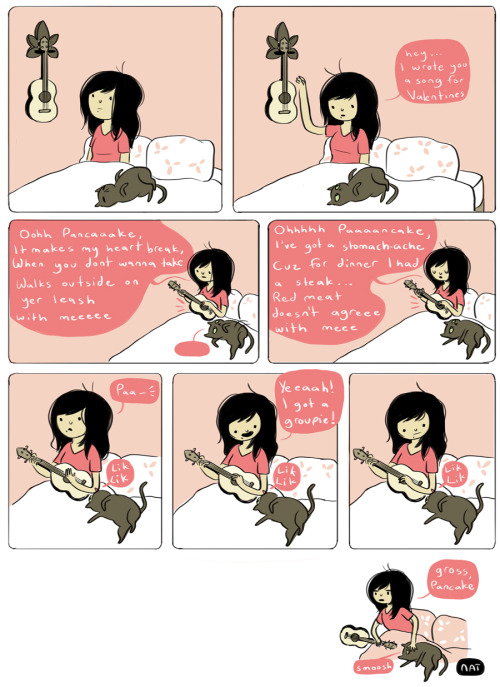
The Pancake Song


Listen to the song!

I may or may not steal this and sing it to "Li'l Snape."

Wednesday, March 30, 2011

Seconded.

I think people were actually excited when Michael Chabon announced he was working on a TV show about "magicians and Hitler." My first thought was, give it a fucking rest. Someone please write a piece on why writers keep setting books during WWII, despite the fact that there are no new angles to work there, seriously, let the ground lay fallow for a while.
- Jessa Crispin

Monday, March 28, 2011

Review: Sucker Punch (SPOILERS) (updated x2)

I am in general agreement with Alyssa Rosenberg on Sucker Punch, which is not a good film, but worth seeing if you find the concept of "Sin City + Return to Oz + Girl, Interrupted" intriguing. Zach Snyder is one of a mere handful of working directors with an immediately apparent visual style, and if he's not known for his subtlety, he at least makes failure interesting, which is more than can be said for most big-screen action-fests these days.

As set-up: After the death of her mother, the unnamed protagonist (called "Baby Doll") attempts to protect her sister from sexual molestation by their stepfather. She accidentally shoots her sister, and this gives the stepfather a perfect excuse to bundle Baby off to a shady mental institution while he enjoys the inheritance left to the two girls. He pays off a corrupt orderly to forge papers so she will be lobotomized in five days. In shock, but knowing her time is limited, Baby escapes into a fantasy world where she and the other female patients are trapped in a bordello and a small group of fellow dancer/inmates agree to join her plan to escape. The interludes where they undertake plan objectives are portrayed via a third dream-level, in which the girls are machine-gun-toting commandos in a series of surreal, war-torn landscapes.

That Sucker Punch owes some debts to Sin City seems obvious, and my impressions of the depiction of female autonomy in that picture go double here. Instead of a political war for independence, we have a Great-Escape narrative, but in each case it's important not to allow the women's scanty costumes to obscure that their struggle is one for freedom: here, freedom from patriarchal and oppressive medical "treatment" meant to silence and suppress them. The decision to play out a similar parallel narrative in the 1985 Oz sequel was widely criticized as being disturbing: when faced with young women telling us things we don't want to hear, the system tends to come down with a cruel and patronizing force.

This is explicit in Girl, Interrupted, but the sexuality of the protagonists is downplayed here, and as Alyssa notes there's no romantic angst playing any part in the characters' motivations, or even their reasons for ending up in confinement. As befits an action movie, the desire is for physical freedom, to be procured through physical means.

And boy are those means physical! Part of my disgruntlement with the pre-release criticism of Sucker Punch was the extent to which the arguments presumed a male audience: Sexy costumes are just there for the titillation of the male audience; violence is there for teenage boys to get off on. But large portions of this movie are effectively video-game style action sequences with an all-woman cast of avatars. They are competent, human, kickass, and emphatically female---but they are not reduced to sexual objects. They are instead excellent vessels for the enjoyment of a female action viewer (and we do exist!). I speculated after the fact whether the choice to make all of the targets in the action sequences non-human was a deliberate decision made to appeal to women.

So there's the surface attraction. But what makes this more interesting than a simple shoot-em-up is the layered structure and what it says about coping and powerlessness. Much of the movie takes place at the middle level, in which the various girls are sex-trafficked workers in a club/whorehouse run by a mustachioed and violent pimp. The girls use their sexuality, via dance and charm, to procure various items necessary for escape. But this level of the narrative is just a proxy for what is really happening in the mental hospital, where the head orderly (the pimp) violates the girls in mostly unspecified ways. There is, thus, a lurking horror at Sucker Punch's heart: What terrors are inflicted on Baby and her fellow patients such that a fantasy of being imprisoned prostitutes (who at least wield sexual power, and are valued, if instrumentally) is a psychological improvement? What "real world" events in the mental hospital occurred to correspond with the brutal murders of two girls and the accidental killing of a third? And how horrible must life be if only through multiple and corrupted layers of distancing can women conceptualize their struggle?

UPDATE: Just saw this post linking to Sady Doyle's review. I'm still finding the hostility mostly misplaced. As one commenter at Coates's blog put it,
[Doyle's] analysis of moviegoing habits doesn't really add up for me. For one thing, it assumes that the primary audience for the girls-with-guns genre is male, and thus apparently has gotten more so since the 80s - which doesn't really square with my own anecdotal experience. Also, the rape-fantasies aside, it seems pretty incoherent to critique an action movie for putting its characters in harm's way - "When its female characters aren't fending off rapists, theyʼre being lobotomized, stabbed, imprisoned, sold, shot in the head, forced to strip, or blown up on trains in outer space." Isn' that basically what action movies do? The question for me would be how prominent the sexual victimization is, and; what kind of reaction - sympathetic? titillated? - it seems to be aimed at provoking from its audience.
The leads in Sucker Punch are not Women in Refrigerators by the conventional definition, i.e. they are not killed or injured as a plot device in a story about a male hero. Even if you broaden the critique to include female characters who are injured and not returned to the status quo, the movie ends with one female character giving her life so another female character can be restored to freedom---hardly a clear case. Perhaps the dead sister qualifies, but she's if anything a plot device in a story about a female hero.

UPDATE 2: I particularly liked Alyssa's interpretation of Baby as someone who chooses oblivion. The fact that the ending seems to have struck many people as jarring or disappointing is partially a function of how it subverts our viewing expectations and partially as understandable discomfort with her decision to embrace her own "mental death" in order for her friend to escape. And yet her choice, albeit regrettable and tragic, is comprehensible: what remains for Baby, on the outside? Everyone she loves is dead. If she does get out, she will have to fight her stepfather to remain free (and may still go to prison), haunted every day by the memory of killing her own sister.

But the dignity of her choice---to embrace oblivion like a lover, and in doing so both escape her own torment and enable someone who still has family to rejoin it---would have been more clear were it not for the MPAA. Because depicting that embrace, within the dream-context of the layered narrative, would have involved a scene of consensual heavy petting with Jon Hamm, and the MPAA would only give a PG-13 rating to that scene if it was re-cut so he was taking her against her will. And Snyder, to whom most reviewers have been willing to attribute all kinds of sexism, didn't want to send that message.

Isn't this fairly strong evidence that Snyder intentionally avoided any actual scenes of rape (which is what the whole dual-distancing is about---when Baby dances and fights, it's obvious, at least to me, that her distracting sexual display/physical struggle is an escape from assaults occurring in the asylum, but this is never presented for our titillation) and instead wanted to show Baby's sexuality as something she ultimately owns and chooses to exercise? It's easy to put all the blame for the muddied themes on the writer/director, but the inclusion of this scene would have underlined Baby's decision and provided welcome contrast with the many previous examples of choice denied.

Friday, March 25, 2011

Ah, the French.

i don't know which part of this post I love best. "Scratchy-backside jam"? Getting your legs measured at the sock store? That in France, "people from [Auvergne] are known as being particularly hard-working and industrious (which is a quality that is both admired, and frowned-upon)"?

Semi-unrelatedly: I highly, highly recommend Mesrine. 

Thursday, March 24, 2011

Signifier Songs

You know how movies set in the Boomers' youth always seem to pick the same few 60s songs to evoke the decade? What 1990s and 2000s songs do you think will be equivalent movie shorthand in the future?

Wednesday, March 23, 2011

Hearts of gold, dull as dross

It is very troubling to me how this post on female characters in SF/F sets up a dichotomy between "convincing women characters" and sexualized women characters/characters that are prostitutes.
A lithe, athletic girl in a tight-fitting leather costume is not a significant improvement, in feminist terms, on a whore.
 I'd think this is true for certain values of "whore," but if the author believes that they're both morally neutral (as I would contend), it's not coming across. Sexuality is part of the human experience. Is there anything necessarily disempowering about sexualizing yourself? What if another facet of your persona is the one being accented? That whores and other sexualized women are more considered objects than persons is a function of sexuality's place in our society, not anything intrinsic to sexualization.

A female character who embraces her sexuality (or even sells it!) can be a "strong," "convincing" woman character. She may not be taking the speculation part* of the speculative fiction where you want it to go, but that's a matter of taste, not evidence sufficient to find the book anti-feminist. In fact, it's possible that the speculated setting could be one in which women can embrace many aspects of their personhood, including their sexuality, without the baggage and judgment and disempowering objectification that make doing so problematic in our world.**

It's one thing if you are bored with male writers defaulting to prostitution as a job for their female characters,*** but there's no need to imply that hookers can't be three-dimensional when the problem can much more easily be attributed to bad writing.


* I don't care if your imaginary world has perfect gender equality (or even eliminates one gender altogether), if the characters are Homo sapiens, then they're going to sexualize themselves and others. Maybe that's not the focus of your book or your protagonist is relatively asexual, but my suspension of disbelief will not extend much further. 

** I willingly admit that this is not what is happening in a lot of SF/F with sexualized female characters.

*** I'm bored as hell with writers using writers as characters: that's even more lazy and gender neutral to boot!

The glorious liberty of unreachability

I didn't get a cell phone until 2003, when I needed to put a number on my resumes for 2L recruiting. With the exception of its cancer fearmongering, this article makes a good case* for the freedom of not having a cell phone. Of course, it's not like calling someone socially is really done these days. I'd gladly swap voice minutes for unlimited texting, but as a grandfathered-in subscriber with an unlimited flat-rate data plan, change scares me.

* One side note: The benefits of a good connection with a land line are undermined by widespread use of speakerphone and cruddy headsets, both on other people's land lines and on their cell phones.

Tuesday, March 22, 2011

Counterpunch

I know absolutely nothing about Suckerpunch except that it's a Zach Snyder joint, so guilty pleasure material, and it's got teeny girls kicking serious ass. And though my inner feminist is usually on a hair trigger, I'm going to drag a companion to see this movie even if it's terrible. But even if it is awful, I'm not sure that this is a really good basis for saying so:
[T]he petite bloodthirsty girly-girls of Sucker Punch still bare their midriffs and cleavages even in what is supposedly their own fantasy scenarios. Maybe I’m alone here, but when I am imagining myself kicking some high-fantasy ass, it’s sheathed in the sort of Kevlar weave, full-body armor that would put a Nolan-verse Batman to shame. Leather hot-pants, after all, have a tendency to ride up when one is jumping out of bomber jets into frenzied combat.
I fail to see the problem. It's not like male avatars of superherodom aren't fit and muscular and don't take great pains to highlight their secondary sex characteristics through inches of steel/rubber/Kevlar. And if you are willing to suspend disbelief in order to make yourself a 100 lb girl ninja paratrooper, are wedgies really a reasonable sticking point? If you want to get all buzz-killer about it, how do you go to the bathroom in Batman-style body armor? Might it not cause you to overheat? Hot pants: Not so much.

If you are fantasizing, why not have perfectly smooth airbrush-tanned legs that bad guys barely have time to salivate over before you kick them in the face? There is no universe where incredible fighting skills + attractive is not >>>>> than incredible fighting skills. What exactly is attractive about a Kevlar jumpsuit? That implies you might get hit. A crop top and daisy dukes says "you will never, ever touch me (unless I want you to)."

(Now the whole bit about male-gazing and using sexual abuse for audience outrage and titillation, probably a good call. But in the grand scheme of things, I am less troubled by obviously fantastical sexism than I am by, say, the pernicious and horrible sexist influence of rom-coms and reality TV. And this has swords and explosions.)

Friday, March 18, 2011

Scraps and tidbits

- Easter's not for a month, but the first day of spring is Sunday! I've got festive seasonal yarn for you.

- Mike asks in comments who the readership is these days. If you're comfortable with doing so, pop up in comments and say hi, maybe how you came to the blog, and what you want to see more of.

- Sometimes I don't think my knitting is ambitious enough:


Nice! These squares are prettier, though.

Tuesday, March 15, 2011

The more things change

Just as I suspected, the "Etsy privacy Valdez" is more of a leaky sailboat:
I'm the founder and CEO of Etsy. I'd like to add a bit more explanation here, because we haven't made any recent or unannounced changes. This is a combination of how things have always worked (feedback), with a feature we launched in October of last year (real names).
What happened? Purchases are made visible via our feedback system, which has not been changed in almost six years. As part of building a trust score on Etsy, buyers leave feedback for sellers and vice versa. We've always linked to the item purchased when feedback is left.
Lots of people on Etsy have identifiable usernames. Many include their real name, or are a recognizable public persona. We saw this, and we also wanted to deepen the trust relationship between buyers and sellers, so we gave all members the option to enter their real name. We feel that being who you really are is an important part of trust on the Web.
We created the option for real names in mid-October. Since then, nothing around this issue has changed. If you put your real name in Etsy, bought stuff, and received feedback, it'd link to the item you bought. Google would also index this stuff.
Did we make a mistake here? Yes, and we worked till late in the night yesterday to take a step in the right direction and plan our next steps: http://www.etsy.com/teams/7716/announcements/discuss/6818578/page/1/ [Ed: link fixed.]
We did not suddenly make some changes without telling anyone. Our feedback system has always linked to items. Additionally, most people on Etsy don't use their real names, and haven't filled these fields in.
We're talking today about what we need to do better, and we'll do it better.
Upshot: You were always Googleable if you put your real name on your Etsy profile. Etsy's change made it possible to find you by searching through the Etsy site by real name or email address.

Of course, now your shopping history is veiled because Etsy has eliminated links in feedback to items purchased and disclosure of feedback left for you by others, which prompts one to ask what the purpose of feedback is, anyway.  (They've kept feedback from you given to others, although there's no link to the other you gave it to, if that makes sense.)

Monday, March 14, 2011

"Cats need to eat a high protein, high water content, small volume meal, i.e. a mouse."

PSA: Do you have a fat cat? This is your solution.

Constant Readers may recall that Snape's leg was mysteriously broken some years ago and that he had surgery to fix it. Because part of his hip was removed (it's held together with ligaments, the body's duct tape), it's important that he not become overweight and stress the load-bearing capacity of his non-joint. Nonetheless, because Snape is history's greatest and most ravenous monster, he got fat. But Lily is and always has been slender. Diet food is exactly what she doesn't need. Male cats also need lots of water to avoid UTI problems.

Enter canned food. Snape lost the 3-5 pounds that put him in the roly-poly category and has not had any other health problems. (Lily is her usual svelte self.) Any cat owner with a pudgy pet should consider this.

Sunday, March 13, 2011

Is chess good for anything?

I love Ta-Nehisi Coates's "Talk to me like I'm stupid" blog feature, in which he asks his very large and civil readership to lecture him on areas that he's interested in but doesn't understand. The inability of people to admit that they lack knowledge and be open to education is a major problem in internet discourse, where bluffing and bullying your way into the winner's circle is all too prevalent.

That said, talk to me like I'm ten years old: What is chess good for? Does teaching your kid chess give them any skills that are useful in other endeavors? (For example, it's often said that learning music helps you learn math, and many sports develop strength and coordination that are generally beneficial.) If you spent your youth playing chess, are you better or worse off than if you devoted a similar amount of time to computer programming, bridge, billiards, or the trombone?

It's totally fine if chess is just for chess's sake; it's not like I'm opposed to impractical hobbies. But I was curious.

Friday, March 11, 2011

Thursday, March 10, 2011

50 Book Challenge No. 5: Ghost Map

I've got a soft spot for books about deadly disease, when they're leavened with personalities and points of human contact. Ghost Map documents London's deadly 1854 cholera epidemic and the discovery, via innovative use of maps and creative thinking, that cholera is spread via contaminated water. Like the lantern overturned by Mrs. O'Leary's legendary cow, a single upended chamber pot started a cycle of rapid and terrifying death. Many factors aligned to instigate the epidemic: A single household's use of a front cesspool rather than the rear, that pool's proximity to a poorly lined well, and the tendency of that well's refreshingly tasty water to draw children and adults for blocks around. The single, dogged doctor who managed to pull the pieces together, John Snow, is artfully drawn as the sort of classic polymath made impossible by our current state of specialization and scientific progress. His triumph over the pseudoscientific theories of his fellows stands as testament to his genius, and one wonders what other discoveries he might have made given a long lifespan (Snow expired early, the price of his using himself as test subject).

The chief quarrel I have with this book is its pacing. Snow convinces authorities to remove the handle from the contaminated pump and the epidemic trails off. However, Johnson spends a few chapters after that establishing that the epidemic was petering out on its own, and that Snow's accomplishment with respect to lives saved as a direct result was arguably nil. After dampening our passion and excitement for Snow's victory for several dozen pages, though, Johnson reveals that the same household in which the epidemic began had one of its last victims. The disposal of bodily fluids from that victim would have reignited the disease and caused it to spread again through the neighborhood with lethal effect---had it not been for the pump handle's removal. Perhaps for someone who read this book in a more detached manner, this about-face would not have seemed as jarring.

The only other issue is that the closing chapter connecting Snow's mapping and discovery with the present day feels tacked on. An editor might have told Johnson that the story of the outbreak and those who fought against it stands just as well on its own, without need for didactic discourses on modern threats. But that is merely a quibble. Recommended.

By request: The Etsy experience

Sarah asks for comments on how my experience as an Etsy seller is going. Today I sold my first custom order (reproducing a one-off colorway on the laceweight base), so emotions are positive for the moment. Dyeing is something I do in fits and spurts, and I've not yet hit the sweet spot in terms of keeping a constantly updated stream of listings. It also takes a while to photograph things well enough to capture colors accurately, which I sort of rolled my eyes about when I saw people say before, but am now intimately familiar with. I have goals of purchasing some additional equipment that will ease or speed the preparation of the skeins for sale: a light box (the current one is handmade, although I suppose I could just make a better one) and a nicer swift.

I did buy an advertisement on Ravelry, which on a per-click basis was much more cost-effective than a Facebook ad would have been. I've also started discussions with a person organizing a book project, so with luck Marli Tharn yarn will be used as the suggested yarn for a pattern or two, which always helps, since many people prefer to use the indicated yarn (sometimes even down to the color shown) for their projects.

Etsy support has been very responsive to requests I have made as a seller, although I am still disappointed that they disabled the advanced search function's capability to search item descriptions. (That affects me more in my capacity as Etsy Stylist than as Marli Tharn proprietor, though.) The fees Etsy charges don't strike me as high, although if I frequently relisted items to raise their position in search results, they would quickly mount. Overall, Etsy strikes me as a very good thing for a hobbyist and potterer. And if it's exceedingly unlikely that you can make a living as an Etsy seller, I deem that part and parcel of working in the arts (broadly defined), not as anything unique to internet sales of craft.

Wednesday, March 09, 2011

Monday, March 07, 2011

By request: SF/F Gateway Drugs

Isabel asks for entry points to either genre for the lit-fic reader, as well as books to avoid. There's an old AskMe on this for fantasy, which is my stronger suit, but I'd supplement or qualify many of those recs. I'm assuming existing familiarity with the "I'm a real author and not part of the genre ghetto" stuff that Atwood, Chabon, Ishiguro, and the like churn out on occasion---those may be of interest, but they are dead ends, genre-wise---they take from it, but do not give back.

Suggestions:

- George R.R. Martin is one of the most popular authors working, and he straddles both genres. If you have any interest in historical fiction or epics, try A Game of Thrones (bonus: HBO series based on this volume starts in spring). For SF, his collections of short stories are better than the novels; Tuf Voyaging gives a good sense of the flavor.

- China Mieville: A prominent author who occasionally draws notice by the conventional literary establishment. His two best books are The City and the City (which is an odd genre-straddler) and The Scar. Prose is not his strongest suit, but for a sense of the New Weird subgenre, there's none better.

- Orson Scott Card: Ender's Game ONLY. Do not pass go, do not collect $200. Useful for analyzing the inner child of many libertarians.

- Connie Willis: If you like your lit fic to put you through an emotional wringer, this is the author for you. Several of Willis's more prominent works revolve around time travel, but she uses this device in the way that (IMO) speculative fiction is intended to be used: as a mechanism for examining the human condition. If you read one, make it Doomsday Book.

- Vernor Vinge: A Fire Upon the Deep and A Deepness in the Sky are awesome, in the sense of inspiring a sense of awe for the universe. It's hard SF for people with souls. Best read both.

- Iain M. Banks: Also writes lit fic as "Iain Banks," so there's a natural progression. The Player of Games is probably the best entry point to his SF work, which chiefly deals with a post-scarcity society populated with humanoids and AIs.

I think Jack Vance is boring as all hell, but he gets accolades for his prose. Likewise, Bujold is often recommended but her stuff can be fluffy and mostly consists of an interminable series about a very short space captain. I have a love/hate relationship with Gene Wolfe's style, which can be opaque and muddled* at times, but if you do wish to try him, The Book of the New Sun is the place to start. Wolfe is meant to be read closely and rewards revisitation.

To avoid, at least for now and possibly forever:

- Neal Stephenson: These are not gateway books; the info dumps are too large, and Stephenson cannot write endings to save his life. Once you're a genre fan, go back and start with either Cryptonomicon or The Diamond Age.

- Ursula LeGuin: Much of her work has aged poorly. The Left Hand of Darkness is the closest thing to a gateway book I could recommend, and I'd really only do so if the reader had a preexisting interest in gender politics.

- Robert Heinlein: If you're not a teenage boy, a lot of his work is silly or distasteful.

- Frank Herbert: Like Heinlein, a titan in the genre, but best recognized for his overall contribution to mythos creation, not for prose or characterization.

- John Crowley: Unless you do a lot of drugs, avoid.

- Mervyn Peake: Gormenghast is ghastly. If someone tries to tell you it's like Tolkien but more literary, first punch that person in the mouth, then run.

Other authors that are NOT what you want: Donaldson, Brin, Octavia Butler, Sheri Tepper, Zelazny, Ann McCaffrey, Walter Miller, Kim Stanley Robinson, William Gibson, Sam Delany, Tad Williams. Some of these folks are fine authors, but they are best appreciated after a period of genre immersion. (Others are horrible, terrible, no-good-very-bad authors. I will not say which is which.)

* Sidebar: Is there a term for when someone takes the unreliable narrator one step further and the author himself becomes deceptive and unreliable? The predominant sensation I have when reading Wolfe is of being shown something through a deliberate haze.

The Definitive Spinach Quiche Recipe

A mixture of Cook's Illustrated, Martha Stewart, and trial & error.

Crust:

1 1/4 cups flour
4 tbsp butter, cubed (frozen or very cold)
3 tbsp shortening, cubed (frozen or very cold)
1 tbsp sugar
1 tsp salt
Ice water

Preheat oven to 375. Process dry ingredients to blend, then add shortening and process for ten one-second pulses. Add butter and repeat. Turn into a mixing bowl and fold in ice water with a spatula, 1-2 tbsp at a time, until the dough coheres into a slightly tacky ball. Turn out onto plastic wrap and squish into a 4 inch disk, then freeze for 30 minutes. Roll out with a little extra flour, rotating after each couple of rolls. Fold in quarters and unfold in a deep quiche pan, turning in any overhang and pressing against the sides. Lightly fork the bottom several times and freeze for 30 minutes. Bake for 25 minutes (pie weights may be used). Remove pie weights if necessary and bake for 5 more minutes. Remove from oven and let cool. (Do not add cheese later if the crust is still hot enough to melt it.)

Filling:

10 oz. raw spinach, chopped and large stems removed (no frozen spinach)
2 shallots
1 tbsp butter
4 oz Gruyere cheese
1 cup heavy whipping cream (do not substitute!)
1 cup milk
2 eggs and 2 egg yolks
1 tsp salt
1 tsp white pepper
1 dash ground nutmeg

While crust is baking, saute shallots in butter in a large, deep pan until translucent. Add spinach, a little at a time, until it is uniformly wilted. Remove, place in strainer, and allow to drain liquids, pressing firmly to encourage this. While the spinach drains further, grate the cheese finely. Beat spices with eggs, then add milk and cream and whisk together.

Alternate layers of the drained and pressed spinach (the spinach should not dribble even a little) and the finely grated cheese in the cooled pie shell, spinach first. Place the quiche pan on a rimmed cookie sheet, pull out the oven rack, and put the whole thing on the rack. Then gently pour the filling liquid into the pan, making sure not to pour all in one spot. Gingerly slide the rack back into the oven.

Bake at 375 for 35-50 minutes, or until top has golden brown spots and the center jiggles only slightly. (Check at 35 and 45 minutes.) Allow to cool at least 10-15 minutes before removing the quiche from the pan.

Follow all directions exactly and happiness will be yours. This filling also works with 4-5 slices of roughly crumbled or chopped bacon in place of the spinach and shallots. Note: Do not add the spices to the milk and then the eggs. Do not grate the cheese too early or with the coarse side of the grater. Do not use half and half in place of the milk and cream. Do not skimp the draining of the spinach. Do not use vodka in the crust---I don't care what you heard. Do not touch the dough directly with your hands except when flipping it to roll and when folding and unfolding it and patting it into the pan. Touch the butter and shortening as little as possible. Do not use all butter; shortening will not kill you. If you use a shallow quiche pan, the baking time will be shorter and you will not have a huge, thick, beautiful slab of quiche. If you don't put the pan on a cookie sheet and your crust develops an invisible crack and leaks egg all over the oven, don't come crying to me.

Sunday, March 06, 2011

By request: What kind of exercise can you stand?

I have never liked sweating. Growing up in Houston, sweating was a gross and omnipresent burden on existence. The humidity hangs over you like a damp towel at all times, making all the sweating completely ineffectual, as if further insult was required. I was eighteen before I realized that people could wear the same clothing item twice without laundering. To minimize perspiration, you ambled from air-conditioned car to air-conditioned building and back again as quickly as you could without breaking a sweat. Not sweating, for a girl from the south, can be raised to a fine art.

Thus my hatred of exercise. People sweat on purpose? Not to win a game, even, or do something arguably artistic, but just ... for its own sake? Disgusting. But at a certain point, one's lifestyle and metabolism conspire to make the strategies perfected as a teen on the Gulf Coast maladaptive. One must exercise, lest you blimp out.

With that preface and qualification, I have managed to stomach the following exercise methods and activities:

- Walking to and from places which one is required to go (work, grocery store, etc.)
- Weightlifting, very occasionally.
- Elliptical machines, even less frequently, and only when completely distracted by a very specific type of audiobook, namely an airplane read/plot crack page-turner.
- Day-to-day activities from which a certain amount of exertion is integral.

I am sure that spinning yarn with my foot-powered wheel burns some tiny percentage of the calories expended in the more famous "spinning" exercises, but that hardly counts.

Saturday, March 05, 2011

That's the internet for you.

Funniest line from the new Bleeding-Heart Libertarians blog:
I didn't realize that this blog was going to be read by so many non-philosophers.

Wednesday, March 02, 2011

Same here.

This is where I'm at, too. Inspiration, please?

Friday, February 18, 2011

50 Book Challenge No. 4: The Scarlet Contessa

Not to unfairly bash The Scarlet Contessa, but I tire of historical novels in which we are lent glimpses into the lives of famous personages from the viewpoint of limpet-like fictional companions with conveniently anachronistic attitudes. Fails as education and as smut. Not recommended.

Thursday, February 17, 2011

50 Book Challenge No. 3: Slammerkin

I went into Slammerkin knowing essentially nothing about it, other than that it was a historical novel set in 18th century England and had a female protagonist. I endorse this method of encounter, and will endeavor to not spoil the book for you.

It purports, in the afterword, to be based on a true story, but the details of the events referenced are largely unknown, and the motivations of the persons involved still less so. The canvas thus prepared for Emma Donoghue's perceptive reimagining, we are drawn into the achingly common story of Mary Saunders's "fall": A mere girl, tarnished forever by sexual impurity, embraces the relative freedom offered by a life of prostitution. After some years of hard and fast living, her options and friends dwindling, Mary makes a daring choice: To impersonate herself, as the girl she would have been, and return to her mother's village on the Welsh border to make a living as a seamstress. A happy ending for Mary is almost within reach, but her emotional ties to the independence of her former life, coupled with the greed and malice of a former client, make clear that Mary is not destined to live a simple life of sewing and children. The strongest aspect of the novel is in Donoghue's characterization of Mary, who does not just have weaknesses, but demonstrates them in organic and believable ways. The ending, though, comes abruptly and does not follow as smoothly from Mary's motivations as her prior conduct. Nevertheless, recommended for historical fiction readers.

Sunday, February 13, 2011

50 Book Challenge Nos. 1 & 2: Catching Fire & Mockingjay

I started off the new year with a little YA fiction: Catching Fire, the second book of the Hunger Games, and the closing volume of the trilogy, Mockingjay. Neither is as good as its predecessor, which required the protagonist to be constantly active and making choices with ethical and plot implications; here, Katniss is strangely reactive, and the reader is dragged into a morass of guerrilla warfare just as she is. The centrality of Katniss to the resistance movement (even as a mere symbol) seems shoehorned and awkward, and too much of the books' suspense revolves around which boy Katniss will pick. Recommended for completists and YA speculative fiction fanboys and -girls.

Wednesday, February 09, 2011

"To enter into a marriage the bar of intelligence and understanding is set low."

Since there has been some blog discussion of this instance in which a disabled man was ordered not to have sex, I thought people might appreciate reading the actual legal decision.
  1. In this case [the testifying psychiatrist] ... proposed the following criteria by way of particularisation:
  2. For capacity to consent to sex to be present the following factors must be understood:
    1. The mechanics of the act
    2. That only adults over the age of 16 should do it (and therefore participants need to be able to distinguish accurately between adults and children)
    3. That both (or all) parties to the act need to consent to it
    4. That there are health risks involved, particularly the acquisition of sexually transmitted and sexually transmissible infections
    5. That sex between a man and a woman may result in the woman becoming pregnant
    6. That sex is part of having relationships with people and may have emotional consequences
  1. The next question is to decide whether the six criteria of Dr Hall do indeed accurately particularise the simple test of Munby J. It is fair to say that neither counsel supports the inclusion of the sixth criterion as an essential ingredient of capacity to consent to sex (viz "an awareness that sex is part of having relationships with people and may have emotional consequences"). I agree. This criterion is much too sophisticated to be included in the low level of understanding and intelligence needed to be able to consent to sex. Apart from anything else, I would have thought that a deal of sex takes place where one or other party is wholly oblivious to this supposed necessity.
  2. Counsel are agreed that an awareness and understanding of the first, fourth and fifth criteria are indeed essential ingredients of the capacity to consent to sex. They are divided as to the inclusion of the second (age) and third (consent). Mr O'Brien strongly argues that the law requires their inclusion; Mr Sachdeva states that "they go beyond the factors which have been expressly stated as being necessary elements of capacity to consent to sex in previous case law".
  3. So the question that I have to answer is this: in order to be able to consent to sex does a person need to have a proper and full(ish) awareness and understanding that sex should only be done by people over 16, and that it should be consensual? It is not an answer to the question to observe that sex with minors, and non-consensual sex, are horrible perversions. There are plenty of paedophiles out there who through warped ideology actually believe that it is morally acceptable to have sex with children. Equally, the prisons have numerous rapists within their walls. But paedophiles and rapists have the capacity to consent to sex.
  4. Mr O'Brien says that this argument is over-intellectual. We are dealing here, he says, with mentally incapacitated people, who in the terms of s2(1) of the Act are suffering impairment of, or a disturbance in the functioning of, the mind or brain. We are not talking about perverts who obviously have the capacity to consent to sex. This is true enough, but I believe that to import these knowledge requirements into the capacity test elevates it to a level considerably above the very simple and low level test propounded by Munby J namely "sufficient rudimentary knowledge of what the act comprises and of its sexual character".
  5. In his evidence Dr Hall emphasised that the need for consent is one of the very first messages that is conveyed to people with learning disabilities who are being taught about sex. Nothing I say is intended to diminish that obviously vital message. There is a difference, however, between the teaching of what is right and wrong in the pursuit of sex, and what level of understanding and intelligence is needed to be capable of consenting to it.
  6. I therefore conclude that the capacity to consent to sex remains act-specific and requires an understanding and awareness of:
    • The mechanics of the act
    • That there are health risks involved, particularly the acquisition of sexually transmitted and sexually transmissible infections
    • That sex between a man and a woman may result in the woman becoming pregnant
After considering "Alan"'s knowledge of various sexual acts and related issues, the judge elected to enter only a temporary order stating that the subject lacked capacity to consent, with the caveat that "the local authority [] provide Alan with sex education in the hope that he thereby gains that capacity."

Incidentally, I passionately hate reading English legal opinions due to the formatting and citation conventions, but the decision to number paragraphs is a very elegant way to circumvent dependence on pay sites for pagination information. Is there some reason why this could not be adopted by judges in the United States?

Tuesday, February 08, 2011

PSA re bookblogging

A friend remarked the other day that I have fallen behind on my book blogging, which has the side effect of making it harder for him to find new books to read. Sorry, folks! I have been reading quite a lot, but I only blog books that am reading for the first time and finish, and quite a few have been discarded partway through or were comfort book rereads. Will catch up with some reviews this week!

Thursday, February 03, 2011

Poem of the Night

Rise like Lions after slumber
In unvanquishable number —
Shake your chains to earth like dew
Which in sleep had fallen on you —
Ye are many — they are few.

Lt. Mary Sue Frey, who singlehandedly talked Hitler to a standstill

I was chatting yesterday about the backlash against The King's Speech, which is a very enjoyable film but is historically inaccurate in several respects. The tweaks to the narrative didn't bother me, as in most cases (such as the Churchill bit), the changes are not really relevant to the focus of the film, which is the relationship between Logue and Bertie and Bertie's struggle to overcome his disability.

My interlocutor then pressed me: How can one despise mendacious memoirists (as I do) but not care about historically inaccurate film narratives? And then I realized that this is all about fan fiction.

Fans love fanfic, and the British monarchy has a lot of fans: history buffs, royalty-obsessed weirdos, pretentious Anglophiles, etc. So we get The King's Speech, which appeals to Windsor worshipers AND people who own the DVD of Pride & Prejudice with Colin Firth. There is a sense in which the viewer joyfully collaborates with the filmmaker to celebrate their mutual appreciation of these historical characters. It is not that the appropriation of extant historical or fictional characters for purposes of short-cutting world-building or characterization is illegitimate; on the contrary, the whole point is that the degree of attention to the desired focus is made possible by invoking our preexisting knowledge and emotional associations. Where the story (here, the story of a friendship between two men of very different backgrounds and of a privileged person being forced to ask a "lesser" man for help) is facilitated by certain facts being elided or altered, it is perfectly reasonable for such changes to be made---the tale is not about Churchill, or Edward's fascist sympathies, or the precise timeline under which Bertie underwent therapy. Adherence to the facts in all instances would distract and detract from our focus, and from our appreciation of the setting and characters for which we already feel such affection.

The James Freys of the world take advantage of this affection for self-aggrandizement. The creation of the narrative is no longer about the world or characters that the writer and reader both love, but about gratifying the ego of the author. Instead of being immersed in a world from the inside, from the perspective of one of its natives, we are shoehorned into a deceitful incarnation that cannot provide the satisfying interactions with our characters and setting we desire as fans or readers: cannot, because each interaction must center around the Sue, not organically grow from what we know about who and what surrounds it.

Nobody likes a Mary Sue. But The King's Speech doesn't have one, and so it didn't bother me.

Monday, January 31, 2011

Complicity

So I just finished watching Spartacus: Blood and Sand and the first two episodes of its prequel series and am feeling very, very dirty.

It's not that I have a problem with nudity and sex (as Constant Readers are aware) and it's not that I find blood and guts on screen a serious problem, although I did turn off Ichi the Killer ten minutes in. But the basic concept of the Spartacus series is to combine the sex of The Tudors with the classical setting of Rome. And there is a LOT of sex, in many instances presented as entertainment for Roman citizens (their enjoyment of which is then presented for our entertainment). The problem is that at least half of the sex acts on screen, which are nearly always shot in the most salacious manner possible, are acts of rape.

Citizens raping slaves. Slaves raping other slaves at their master's behest. Slaves raping other slaves on their own initiative and without sanction by a master. Slaves being given as sexual playthings to both free citizens and other slaves as incentives in various plots. Perhaps the most remarkable part is that it probably contains more acts of sexual assault against men (by both male and female perpetrators) than any show since Oz. I don't know what the reaction of a male viewer would be, but I'd venture to guess that any inclination to perceive the sexual acts as more than "ooh hot people doing it" would rouse substantial discomfort.*

The part that unsettles me is that although the cumulative effect of viewing the series was to very effectively underline exactly how many ways people can have their sexual autonomy violated,** I still managed to plow right through to the end, where, as promised, Spartacus goes all "Spartacus!!!" and kills everybody. But I absolutely refuse to watch Boys Don't Cry or Irreversible, on the grounds that I just can't handle the rape scenes, no matter how terrific they may be as pieces of cinematic art and virtuoso acting. Spartacus is, to put it kindly, not destined for greatness in those regards. And yet here I am, checking for the air date of episode three.*** Somehow I doubt my reaction would be the same to a miniseries documenting, say, the St. Domingue slave revolt. 

* It's all very well to think that being Lucy Lawless's private stud wouldn't be so bad, but even this glossy film portrayal of it makes you think twice.

** Along with the banal monstrosity of the citizen class, which is done well enough that one ends up cheering on the brutal murder of a callow teenage boy.

*** For now I'm going to blame John Hannah and his character's manifold schemes,**** which make it sort of plot crack even when you know how the characters are going to end up. The dude had a lot of built-up capital from my love of The Mummy***** and Sliding Doors.

**** Also Asher, who basically lives by the motto "What Would Iago Do?"

 ***** Which, relatedly: Arnold Vosloo on Bones! But with hair! Do not want!

Saturday, January 29, 2011

The Naked and the Nude

Tom Ford on nudity:
I’m very comfortable with naked bodies. Someone asked me recently about male nudity, and I brought up the subject that, in our culture, we use female nudity to sell everything. We’re very comfortable objectifying women. Women go out and they are basically wearing nothing. Their feet and toes are exposed, their legs are exposed, their breasts are exposed. Everything is exposed—the neck, the arms. You have to be really physically perfect, as a woman, in our culture to be considered beautiful. But full frontal male nudity challenges us. It makes men nervous. It makes women nervous. Other times in history, male nudes have been regarded in a different way. The Olympics were originally held nude. The reporter I was explaining this to said, “This would make a great story.” I explained how when I come home I actually
take off all my clothes, and I wear no clothes until I leave. I eat naked. I do everything completely naked. He said, “That would make a great interview.” I said, “Fine, we have to do it nude.”

CURRIN: How old was the interviewer?

FORD: Oh, 55 or 56. [Currin laughs] He was in very good shape. Anyway, we did the interview. The interviewer was straight, and I made it a point to desexualize the interview even though I was sitting with my legs wide open, completely naked. At the end of the interview, I put on a dressing gown and he put on his clothes, and I sat next to him on the sofa and said, “Was that sexual?” He said, “Absolutely not.” And I said, “That’s because I didn’t make it sexual.
There is nothing like a trip to Spa World to desexualize nudity. (via)

Thursday, January 27, 2011

Scary fact: Paris Hilton and I are basically the same age.

Hugo Schwyzer contends that modern girls are trapped in a "Paris paradox," in which they feel pressured to be sexy without being authentically sexual. I'm not sure that this is a new phenomenon, or even new in the 2000s. When I was in high school (fifteen years ago! wowsers), a clique of the high achieving girls started some club called the Temptresses, which apparently involved sexy Temptress names, sleepovers with videos of them eating strawberries and whipped cream, and public recounting of said exploits, but no actual sexual activity. A friend and I quipped that we ought to start a parallel Seductresses society, the motto being "we get results," and oriented toward, you know, hooking up with boys we liked, not homosocial performance art.*

It never occurred to me before now to connect the high academic achievement level of the Temptresses with their embrace of the sexy-but-not-sexual, but in retrospect it seems obvious that most of them probably felt familial and internalized pressure to devote their time and energy toward Amy-Chua-approved pursuits instead of teenage romance, but still wanted a social stamp of approval on their femininity and desirability.

Or maybe they just really liked whipped cream. Shrug.


* Bonus: I already had the trashy Seductress name.

Phallic Swords of Damocles

My friend Alyssa Rosenberg highlights one respect in which historical fiction, written and filmed, almost always fails:
I think one thing that most movies set in the semi-Medieval through Victorian eras don't really get at is the absolute horror of arranged marriages. Sure, sometimes they worked out, and you ended up with someone you'd come to love, or at least live companionably with. But can you imagine being married off to someone forty or fifty years older than you? Someone who had absolutely no interest in you except for raping you? Who ignored you altogether? Who physically abused you? And all in a world where there were no resources [for] you, much less any concept of choice in the matter?

I can't, really, and I imagine most contemporary writers can't either.
Even if you were not forcibly wed or if your forced marriage turned out relatively well, the fact of being married to someone meant that he could demand sex at any time and you were obligated to acquiesce---sex that could lead to a life-threatening premodern pregnancy and childbirth. That these circumstances did not result in a subjective experience of constant terror for their victims makes them no less morally horrifying.

Wednesday, January 26, 2011

Law school a scam?

Somebody asked me the other day why I hadn't posted about this NYT article about whether law schools are scams. I didn't because I've said my piece on law school generally and don't like coming off as Bitter Lawyer Girl when, really, I went to a very good law school and am glad that I did and became a lawyer and not, say, a consultant or an i-banker. But other people have snarked on the article and they are funny:

Supply and demand should have caused these lower tier schools to lower their costs to entice students away from the better but more expensive schools.  But they don't need to, because all law schools are free.  Read it again.  All law schools are free.

Not after you graduate, of course, but right now.  Law schools can charge anything they want because everyone has enough money to pay for it- today.  As long as there are guaranteed government loans available for this, there is no economic incentive to lower the costs.  And as long as the price is zero, demand will always be infinity.

If it was true supply and demand, #1 ranked Harvard and #100 ranked Hofstra wouldn't have the same tuition.  But they do, the same as stupid Washington University, which is so stupid it's in Missouri.  "It's underrated."  Bite me.  Are we saying that Hofstra's worth the same money as Harvard?  That people would pay anything to go to Hofstra?  No, they don't have to pay anything to go to Hofstra.  That's the point. 
What I found particularly amusing about the NYT piece is that the profiled graduate went to law school in San Diego but didn't want to work there. When I was interviewing for newbie lawyer jobs, scuttlebutt was to not even bother trying to get a job in San Diego without some preexisting connection, because so many people just try to get jobs there for the weather that they don't take out-of-towners very seriously. Likewise, when I talked to people about New York jobs, people noted that graduates of lower-tier schools located in NYC have a leg up over graduates of similarly ranked institutions elsewhere. But here's this guy, who obviously had to pay full freight at a low-ranked school, doing the exact opposite of what might have helped him. Of course, it's not like I knew that stuff until after making a law school choice either, but might it not have occurred to him? Oh well.

Tuesday, January 25, 2011

The Art of Travel, continued

This post at Ta-Nehisi Coates's blog on the ethics of slumming (and Coates's subsequent admission that he would stay at an all-inclusive resort, which, hello, of course you would---who among us is too self righteous to appreciate the ultimate lazy vacation, in which no financial decisions or coordination problems interfere with your pina colada consumption and complete sloth? but I digress) made me reflect on my philosophy of travel. I've not taken a vacation in a while and am contemplating a solo trip to Namibia or Cambodia (although a friend went to Sao Tome some time ago and it looked awesome).

However, in the course of a recent conversation I reiterated my position on travel, which is that I don't interact with people while I'm there. I see things, and places, and art, and history. I travel to rationalize the sense of alienation and dislocation I feel on a day-to-day basis and throw it into sharp relief, not to make friends. But is this somehow even more insulting than poverty tourism (although it's equal-opportunity; I am just as aloof in rich countries as in poorer ones)? It's not that I look down on people I meet; it's that the stress of trying to connect with them interferes with my engagement of whatever relaxing and cool thing I came there to do. Trouble is, I am running out of destinations where there is stuff that I already am interested in. Future destinations are going to involve me learning to appreciate new stuff, and that's hard to do with minimal social interaction.

Friday, January 21, 2011

Brilliant.

So, those stand-alone turkey roaster countertop ovens? Just about the perfect appliance for yarn dyeing. And here I was thinking I needed stockpots and outdoor gas burners.

Thursday, January 20, 2011

Does Not Compute

Busty women, chill with the persecution fantasies.

If you're feeling like a freak, you're not alone. Bra sizes have risen from an average of 36C to 36DD in the past decade. And it's not just America: in the same decade, British women went from 34B to 36C. A lot of this is attributable to the overall fattening of both nations, but pound gain doesn't always equal cup gain — and many women aren't overweight, but are still obscenely top-heavy. Other potential causes: implants; the Pill; hormones in factory-farmed food; hormones secreted into water supplies by contraceptives.


2. Vicky is dead to you. This is the oft-questioned "secret": V. (um, duh, she's an alien) advertises with models who wear your cup size, but doesn't actually sell bras that fit them. In all matters relating to your top half, scorch her from the earth. (Her undies are cute, though.) This also goes for your old pals Gap, Target, et al. They are mass-market and your tits are not. At least you can still get socks pretty cheap? (emphasis added)

Mass-market stores don't carry items that fit the average woman? I can believe this for trendy stores that don't want to be seen as where the chubby ladies shop, but since when is Target that cool?

Tuesday, January 18, 2011

Price points

I was all set to read this book Yglesias mentioned, but the Kindle edition is $41.73. Forty-one seventy-three. WHY.

Friday, January 14, 2011

That Tiger Mother

Like everyone else, I read the infamous WSJ excerpt from Amy Chua's book. And like most people on the internet, I was repulsed. Why (aside from the crazy emotional abuse)? Because Amy Chua's goal is to raise little Amy Chuas. And Amy Chua is nobody to emulate.

From Metafilter:
i'm having trouble reading Chau's article as anything other than a passive-aggressive push in a deeply troubled marriage. She's revealed only tense moments between them in just a 2,000 word article. Jed Rubenfeld, her husband, in addition to his law accomplishments, published a novel and once studied theater at Julliard. That seems to put her "no school plays" comment into context.
I cannot imagine having children with someone and then communicating to them with your every fiber of being that you wouldn't want those children to be anything like them. Why marry him at all? Why not a Chinese guy?

Chua explicitly states that her goal is to sideline "Western" parenting strategies and use the techniques with which she was raised. They were (and will probably be) very efficacious:
If you're trying to figure out if her method works or if it is harmful some other way, you're missing the real disease in her thinking. She's not unique. the disease is powerful and prevalent, it is American, but a disease nonetheless. (No, this time it's not narcissism.)

I'll explain what's wrong with her thinking by asking you one simple question, and when I ask it you will know the answer immediately. Then, if you are a parent, in the very next instant your mind will rebel against this answer, it will defend itself against it-- "well, no, it's not so simple--" but I want to you to ignore this counterattack and focus on how readily, reflexively, instinctively you knew the answer to my question. Are you ready to test your soul? Here's the question: what is the point of all this? Making the kids play violin, of being an A student, all the discipline, all of this? Why is she working her kids so hard? You know the answer: college.

She is raising future college students.
And what do you get?
She confesses in her book that she is “not good at enjoying life,” and that she wasn’t naturally curious or skeptical like other law students. “I just wanted to write down everything the professor said and memorize it.”
You can be a Yale Law professor and still a failure as a human being.

Happening Friday Night

Twins aren't delicious!

Despite not believing in the slightest in astrology, I am discomfited by the idea that I am no longer a Cancer. Then again, I hate random changes most of the time.

Monday, January 10, 2011

Witchy Nose = My Beauty Secret

I wonder how these research results mesh with the phenomenon of the pretty-ugly runway model.

Wednesday, January 05, 2011

Singing to the cat

You're the cutest Snape and that is that/
You're the cutest Snape and nobody's cuter/
Nobody, not even Hans Gruber
...
Actually, exceptions have to be made/
for Die Hard 1, I take that back.

Weekend Bake: Sausage Kolaches?

I went back to Houston for the holidays (squeaked out just before the snow caused mass cancellations) and had some sausage kolaches from the local bakery. Doughnut shops are one of the things I miss the most about Texas. In the DC area, just finding a doughnut shop that isn't Dunkin can be a challenge, and nowhere seems to make the deliciously light, airy yeast doughnuts that are par for the course in Texas bakeries. But worse yet, you will never, ever find in a DC doughnut shop that lovely and ambrosial breakfast item, the sausage kolache.

Some people claim that this isn't a kolache, it's a klobasnek. To which I reply: Maybe if you're in Europe. If it's here, and it's Tex-Czech, it's a kolache, damn it. There are no klobasneks with jalapenos.

Although one of my favorite Texan food blogs has a recipe for kolache dough, I had held back on attempting to replicate this foodstuff because the central ingredient, namely the sausage, posed a problem. If you go to a grocery store in Texas, you are likely to be confronted by a wall of sausage options (seriously, I wish I had snapped a photo when I was in H.E.B.---it was literally 10-15 feet of nothing but sausage). Here in DC, you are lucky to find decent kielbasa, much less something appropriately sized and worthy of encasement in sweet yeast dough. But then I saw someone mention New Braunfels Smokehouse, and I realized that mail order sausage might just be the ticket. Maybe not from there, but somewhere.

I will keep you up to date with the results of this experiment.

Tuesday, January 04, 2011

50 Book Challenge 2011

I have been reading a LOT lately. The 50 Book Challenge format (previously; even previouser) at least gives me a framework for keeping track of things. I'll be writing short reviews of the books I read throughout the year and add them to the list below.
  1. Catching Fire
  2. Mockingjay
  3. Slammerkin 
  4. The Scarlet Contessa
  5. Ghost Map 
  6. Hater
  7. The Broken Kingdoms
  8. Tooth and Claw
  9. The Drowning City
  10. Medicus
  11. Persona Non Grata
  12. After the Prophet
  13. The Forsaken
  14. The Hangman's Daughter
  15. Beat the Reaper 
  16. Medicus, 
  17. Terra Incognita
  18. Persona Non Grata
  19. Mao's Great Famine
  20. The Bone Palace
  21. Troubled Waters
  22. The Heroes

Monday, January 03, 2011

Some things never change

The world turns, the year is new, but Ross Douthat is still an idiot. While it's true that the availability of safe, legal abortion has accounted for some of the modern scarcity of adoptable infants, and the acceptability of single parenting (or unwed co-parenting) for some of the rest, widely available birth control has probably accounted for a huge percentage of the "missing" adoptable infants.

I'm fascinated by his description of the waiting list for adoptive parents as "lengthened beyond reason." What would be "reasonable"? Forcing some "working-class and undereducated" woman through pregnancy and childbirth and then pressuring her with 1950s tactics to hand over her baby? Pushing other nations to repeal the laws they've enacted to protect children within their borders from being stolen and passed off as orphans? I look forward to proposed solutions from the Very Thoughtful Beard.*

Douthat is opposed, IIRC, to widespread use of the sort of reproductive outsourcing that Melanie Thernstrom used to get her two infants. (Contra IOZ,** I don't think his failure to comment accordingly is evidence of his lack of opinions on the subject; Douthat knows that any moral condemnation of reproductive technologies embraced by the NYT readership and advertising audience is likely to be left on the cutting room floor.) But if we can't divorce the experience of pregnancy from the contribution of genetic material, how can we make more unwanted babies, when women, exercising sovereignty over their persons/means of production, have made it manifestly clear that unwanted babies are not a desired good?

* Who may still believe that we are somehow morally obligated to create as many unwanted babies as possible.

**IOZ is correct to note, however, that Douthat's description of the American entertainment industry's alleged discomfort with abortion is off the mark: "It's worth noting that the entertainment industry is not so much uncomfortable with abortion as it is viciously opposed to women, which is why it spends so very much of its time kidnapping, raping, murdering, molesting, humiliating, and hating on them"